
Festivals and Pilgrimages
Updated on 10/12/2025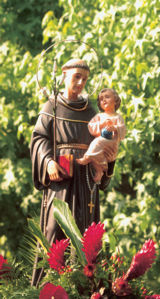
The year is 1195, and on August 15th, another boy is born in Lisbon. He was baptized with the name Fernando de Bulhões. No one could have predicted that this boy would become known worldwide as a Saint.
At the age of 25, he took the Franciscan habit at the Monastery of Santa Cruz in Coimbra, where he became known as Friar António.
Indeed, there is no one more famous, more sought after, and also more ready to perform miracles than Saint Anthony of Lisbon. Nicknamed the “Marriage Saint,” “Protector of Animals,” “Restorer of the Lost,” “Deliverer from Demonic Temptations,” “Patron of the Merchant Class,” “Saint of Miracles,” everything is asked of him not merely as an intercessor but as a celestial authority.
In Portugal, Saint Anthony is very popular and one of the most venerated, though he rarely appears as the patron saint of cities and towns. Vila Verde is no exception, and although he is not the patron saint, he is the most venerated.
It is known that at least since 1706, he has been venerated in the Chapel of Saint Anthony in the very center of Vila Verde. The Parish Memories of the Geographical Dictionary of 1758, which King José ordered to be compiled, confirm this: “there is a hermitage, it has a chapel called Saint Anthony of Vila Verde… where… pilgrims gather on the day of Saint Anthony, the day of Saint Lucy, and the day of Saint Blaise…”
Today, the Anthony festivals continue to take place over several days, attracting thousands of people from northern Portugal and neighboring Galicia. June 13th is a municipal holiday. The days leading up to June 13th are filled with preparations for the event: festival arches illuminated along the main streets, entertainment for children, stalls with treats and popcorn, traditional food and drink taverns, vendors selling various products throughout the fair, and loudspeakers playing music for all tastes create movement and joy.
The coexistence of the secular and the religious occurs throughout the festival days, constituting one of the richest expressions of popular culture and offering strong and varied attractions.
The Eucharist, with a sermon dedicated to Saint Anthony, the procession with numerous participants—especially children—the floats decorated with fresh flowers, flags, and other banners provide a spectacle of colors: yellow, red, blue, green…
Thousands of devotees join the procession in gratitude for graces granted by the Saint.
At the rear of the procession, music bands play various pieces all the way to the Main Church. Passersby stop and gather on the sidewalks to watch the procession. Acts of penance, fulfillment of vows, offering alms, and kissing the image of the Saint are the main manifestations of the population’s faith.
Other types of entertainment continue throughout these days: groups of “Zés P’reiras,” giants, and big-headed figures announce the festival early in the morning. The international folklore festival, singing challenges, sports events, musical performances by nationally and internationally renowned groups, various contests, exhibitions, traditional games, horse races, and many other events fill the festival program.
On the nights of Saint Anthony, fireworks, bonfires, parades, and grilled sardines create moments of spontaneous socializing among all attendees until the early hours of the morning.
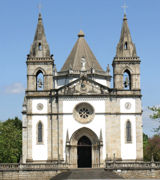
The Sanctuary of Our Lady of Relief is located in the place of Alívio, in Soutelo, beside the national road that connects Vila Verde to Braga.
It is a building of very simple characteristics, with a rectangular floor plan, whose façade features two towers and a triangular pediment topped by the image of the Virgin and Child.
The interior is marked by the presence of six pilasters, between which large windows open, supporting the arches that structure the vaulted ceiling.
Its construction, which began with a small chapel, is attributed to Reverend Francisco Leite Fragoas, in fulfillment of a promise to Our Lady after he suffered a serious illness.
The Sanctuary of Alívio is an important center of pilgrimage, as proven by the constant presence of pilgrims, especially on Sundays, when a small fair also takes place. However, the most important days are the second and third Sundays of September, when the pilgrimage in honor of Our Lady of Relief occurs, with the processions taking on particular prominence. The procession of the first Sunday, which leaves from the Sanctuary and returns there, is characterized by the presence of several floats, especially that of Our Lady of Relief, as well as many participants carrying flags and other banners. The procession of the second Sunday is marked by the gathering of pilgrims in two distinct places: the center of Vila Verde and the Wayside Cross of the Four Evangelists in Soutelo. From these locations, the pilgrims proceed in procession to the Sanctuary. In addition to the processions, on both days there is an outdoor mass, fulfillment of vows, and a fair.
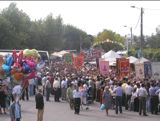
The participation of thousands of people in the different activities held on these days is an expression of the deep religiosity of the people of the region, also observable in the offerings to the Sanctuary. Ex-votos and iconography of the most varied types are gathered in the Chapel of Promises. Of particular note is a set of four pythons, one of which was offered in 1818 by an emigrant in Brazil.
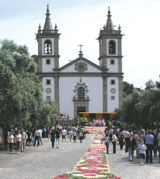
Located in the parish of Cervães, the Sanctuary of Our Lady of Good Dispatch was built in the 17th century. The façade is typically Minho in style, with simple and harmonious contours and two tall bell towers. The floor plan is rectangular, and the altar is situated between two large rocks that give it the appearance of a grotto. The first mass was celebrated on August 10th, 1644.
The founder of this Sanctuary was the hermit João da Cruz, born in the parish of Bela, in Monção. While gravely ill, he asked God for healing and promised to build an altar dedicated to the Virgin if he recovered. With the alms he received, he began the construction.
The first Sunday of June is the day of the annual festival, which includes a procession, an outdoor mass, and a fair. On the eve of the celebration, the image of Our Lady is taken to a church in a neighboring parish, either in the municipality of Vila Verde or Barcelos.
From there, the procession begins and ends at the Sanctuary of Our Lady of Good Dispatch. The participation of the local population in organizing this festival is immense. The different neighborhoods of the parish build arches along the streets where the procession will pass, decorating them with flowers and regional scarves. On the ground, they create flower carpets with vegetal and religious motifs, which, together with the arches, create a vibrant and colorful atmosphere.
The rivalry between the neighborhoods of the parish is also a tradition and is expressed in the size of the “arruado,” the set of arches built, and in the beauty of the flower carpets.
On the day of the procession, bedspreads are placed on the windows as a sign of devotion, joy, festivity, and respect for the Virgin. Children are given the task of throwing flowers as the float passes.
In accordance with the promise that led to the construction of the Sanctuary, Our Lady of Good Dispatch is primarily invoked for the granting of graces related to health.
However, she is also asked for protection regarding fertility and pregnancy, as well as for agricultural production.
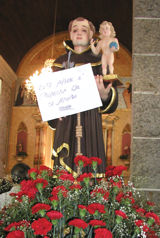
The Sanctuary of Mixões da Serra is dedicated to Saint Anthony, whose celebration takes place on June 13th. It is located in Mixões da Serra, in the parish of Valdreu, in the most mountainous area of the municipality of Vila Verde, and hosts one of the region’s most emblematic traditions: the Blessing of the Animals.
The origin of this tradition is linked to the protection that shepherds sought from Saint Anthony after a period during which their herds were decimated by wolf attacks and plague. As a sign of gratitude, the Chapel of Saint Anthony of Mixões da Serra was built, which would later give rise to the current Sanctuary. Its construction date is unknown, although the date inscribed on the wayside cross associated with it is 1607.
The festivities of Saint Anthony take place on June 13th, the day on which various religious activities occur. However, the most important day is the Sunday immediately before. On this day, the square in front of the Sanctuary fills with thousands of people and animals participating in the ceremony of the Blessing of the Animals.
From the break of day, in the areas surrounding Mixões da Serra (municipalities of Vila Verde, Ponte de Lima, Terras de Bouro, Arcos de Valdevez, Ponte da Barca), groups of people and adorned animals make their way in pilgrimage to fulfill promises or to seek the Saint’s protection for their animals. Nowadays, the animals participating in this ritual are not only cattle, but also horses, goats, sheep, and even dogs and cats.
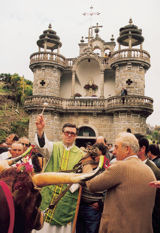
One of the elements that gives this ceremony its special character is the fact that the animals are blessed one by one. Indeed, at the end of the outdoor mass, the priest slowly walks around the grounds blessing each animal. In addition to the Blessing of the Animals, there is also the fulfillment of vows, which may include walking around the Sanctuary—on foot or on one’s knees—carrying wax figures of animals, as well as moments of prayer inside the Sanctuary.
Alongside these religious acts, Santo António de Mixões da Serra fills with food and drink stalls, improvised restaurants, and vendors selling fruit, bread, and traditional sweets. The festivities are enlivened by folklore groups, singing duels, music bands, and a fireworks display that brings the celebrations to a close.