
Folklore Groups
Updated on 02/12/2025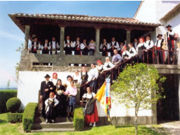
To raise funds for the works taking place in the church and parish residence, Father José Barbosa Granja, the parish priest, gathered a group of people from the parish to sing the “Reis.”
From then on, they continued working for the culture of the parish, forming the Folkloric Group of Moure on August 10, 1988.
Most members belong to a young age group who, on a successful journey and through volunteer work, bring the ethnographic traditions of our land to various regions of the country and abroad.
The dances and songs are characterized by the color and rhythm of the Lower Minho, relying predominantly on viras, malhões, and chulas, which are highly representative of a bygone era.
Among the costumes, the bridal attire stands out—an emblematic costume of the municipality—as well as the moleira outfit, traditional in Moure, the senhorinha of Gondomil, the Sunday best, the fairgoer’s attire, and rural clothing, since the group represents an essentially agricultural area.
The men’s costumes match those of the women.
The tocata is composed of concertinas, guitar, viola braguesa, ferrinhos, cavaquinhos, reco-reco, bass drum, and castanets.
The group includes a male singer, a female singer, choir members, and performers, and is composed of approximately 50 members.
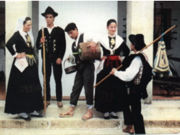
The Vila Verde Folkloric Group was founded in 1958 with the purpose of preserving and promoting the ethnographic traditions of the municipality of Vila Verde.
It has participated in numerous and varied folkloric festivals throughout the country, from Minho to the Algarve, including EXPO 98 and the Autonomous Region of Madeira in 1999; abroad, it has performed several times in Spain, including the Canary Islands – Tenerife (2002), as well as in France and Germany, and also in Austria (1983), Italy (1984), and Slovakia (1993).
As part of its activities to disseminate and promote folklore, it has recorded, to date, 4 vinyl records, 1 CD of Christmas Songs, 1 CD reissue of the vinyl record “Traditional Music and Songs of Vila Verde,” several audio cassettes, and 1 video cassette included in the national project “Portuguese Folklore,” representing the district of Braga. It has performed on RTP several times; it organizes the annual Santo António Folkloric Festival – Portuguese/Spanish, and since 2001, the InterNations Folkloric Festival, which has brought to Vila Verde people and cultures from all over the world; it has also produced radio programs and exhibitions of costumes and musical instruments.
It is an active and founding member of the Portuguese Folklore Federation, where it holds a position on the Technical Council, and it is registered with Inatel.
In 1983, upon reaching its 25th anniversary, it was awarded the Municipal Merit Medal.
In 1992, by governmental decree, it was recognized as an Institution of Public Utility.
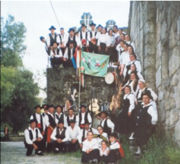
The Folkloric and Ethnographic Group of the Social Center of Pedregais was founded on April 6, 1998, with the aim of recreating the traditional environments experienced by its ancestors.
It has participated in numerous folklore festivals throughout the country. In the years 2000 and 2002, it performed in France and Spain. It has recorded tapes and a CD with its music and songs. This group is made up of about 50 members. The costumes represented are those of the reaper, the shepherdess, and the Sunday best. The men’s costumes partially correspond to those of the women.
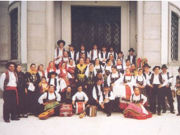
The folkloric group Lavradeiras de Parada de Gatim was founded on June 14, 1969 with the aim of preserving the region’s folklore and keeping alive the customs, dances, and songs of its people.
With absolute seriousness regarding costumes, dances, and songs—combined with the naturalness, communicative joy, liveliness, and enthusiasm of its members—the group has achieved great success, participating in major national folklore events and bringing joy to local festivals. Their performances have also been well received on television, having appeared on RTP, German TV, BBC, and Irish TV. To ensure that future generations can remember and appreciate the charm of the region’s traditional songs, they have recorded two LPs, nine singles, and one CD.
They have performed in numerous national folklore festivals and abroad, including Germany, France, Spain, the Netherlands, Belgium, Luxembourg, England, Italy, Hungary, and Ireland.
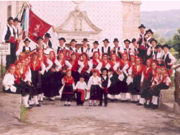
The Folkloric Group Nova Esturdia of the Peasants of Godinhaços was founded on May 10, 1982, with the aim of preserving and promoting the customs and traditions of the Municipality and the Region.
They have participated in folklore festivals throughout the country and in neighboring Spain.
They have recorded two cassettes featuring some of their work.
The Folkloric Group of Nossa Senhora da Pena of Carreiras S. Miguel was founded on August 15, 2000, with the aim of collecting, preserving, and promoting the traditions and customs of their region.
The costumes represented include the Sunday attire, Work attire, and Bride attire. Throughout its existence, the group has performed throughout the country and has recorded a CD.
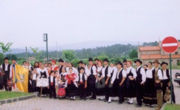
The Folkloric Group of Cervães was founded on June 11, 1990, with the aim of collecting, preserving, and promoting the customs and traditions of the region.
The initiative to establish this folkloric group came from a group of men from the parish who participated in a rusga during the Festa de Santo António in Vila Verde. They presented the idea to the presidents of the Casa do Povo and the Parish Council, thus founding the Folkloric Group of the Casa do Povo of Cervães. When formalized in the Diário da República, the group adopted its current name. They have recorded cassettes with their music and songs.
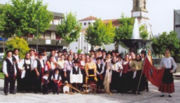
In 1982, a group of people from this parish founded the Recreational and Cultural Association of Marrancos, with various sports and cultural activities.
The desire to form a folkloric group materialized in June 1983. Composed of 55 members, the group has performed numerous times across the country. The costumes represented by the group reflect those worn at the end of the 19th century and the beginning of the 20th century.