
Costumes
Updated on 11/12/2025The costume of Vila Verde, like any traditional attire, reflects the life of the people who wore it in the 19th and early 20th centuries. It is richer and more varied for women than for men.
Thus, there are three main variants of the costume, which indicate, by themselves, the activities of the wearer—whether for work or leisure. These variants are: the Hillside Costume, which is a festive outfit, also called the Sunday Costume (Domingueiro) because it was worn on Sundays to attend mass; this has a variant, the bridal costume, in which only the woman’s attire differs, with elements such as the bouquet, umbrella, tulle veil, and shawl.
The second main variant is the Riverside, Farmer, or Market Costume, which indicates, as its name suggests, its use when the man or woman goes to the market. It is a costume that seeks a certain balance between the Sunday costume and the work costume, thus positioning itself in a middle ground. This is indicated by the colorful scarf or shawl the woman wore to cover the bust, or by the cachené she placed on her head. For men, little or nothing changes compared to the Sunday costume.
Finally, the third variant, called the work or general-use costume, is, as the name indicates, the work costume. Here, notable elements include the straw hat, commonly used in the fields to protect the worker from the sun, as well as boots, thick socks, clogs, the croça, etc.
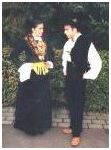
Costume intended for the Wedding, Festival, and Pilgrimage, and, finally, reserved for the Shroud. It consists of the jacket or coat, skirt, and apron adorned with beads, velvet, satin, and lace, where black predominates, contrasting with the abundant gold and the white of the veil, or with the bright colors of the carpet, engagement, or lover’s handkerchiefs and sash. For all these reasons, it is the quintessential costume of Vila Verde, originating from the hills of this municipality and the lands of Bouro.
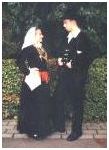
The Men’s Sunday or Festival Costume is not as elaborate as the women’s, which is why it does not vary much from village to village or even from region to region. However, on special days, such as festivals and pilgrimages, the local men dressed up wearing trousers, a velvet vest, and a coat or jacket (with gold or silver braid), predominantly in black, accompanied by soft leather shoes stitched in white with red trim, or leather boots, carded or not, contrasting with a linen shirt embroidered in red and/or white, a black or red sash, and a predominantly black hat.
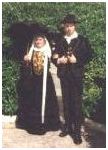
The Bridal Costume, a variant of the Hillside Costume, is the ceremonial continuation of the Sunday or Festival Costume. In both the female and male versions, the predominant color is black. The man wore black trousers and boots suitable for ceremonies, a linen shirt embroidered especially in white, a black velvet vest and coat, and a black hat. The woman wore a black skirt, apron, and coat richly adorned with beads, velvet, and lace, along with black slippers contrasting with white stockings. White was also present in the cotton tulle veil, also embroidered in white. Abundant gold was a mandatory feature on this day, symbolizing the bride’s dowry.
Uniquely, the bride did not carry a bouquet in her hand but a small sprig of orange blossom placed on the left side of her chest with long white silk ribbons hanging, symbolizing her purity. In addition, she carried a silk shawl on her right arm, representing her trousseau, and also a parasol to enhance the beauty of her attire.
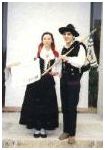
The Riverside, Market, or Farmer’s Costume originates from the eastern and southwestern parts of the municipality of Vila Verde. It is considered the second most important costume of the region, as the markets were, and to some extent still are, the main hubs for trading crops, agricultural products, and domesticated animals.
For women, this costume consists of a black vest or bodice adorned with beads or embroidered linen as desired; a black skirt and apron; a fine white-embroidered linen blouse; and accessories including a small purse, a shawl, and a cachené (headscarf). The male costume varies little or not at all from the Sunday costume.
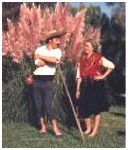
The clothes that people wore in their daily lives, that is, for their hard agricultural work, were commonly used for all types of labor. As such, the oldest, most worn, most durable, and most practical items were used, such as a simple skirt paired with an apron woven on manual looms, or corduroy trousers, chancas and clogs, coarse linen blouses or shirts, and straw hats to protect from the sun or even rain. In the men’s Work Costume, the croça, used by herders or cattle callers, also appears.