
Myths
Updated on 09/12/2025
The Bridge of Prado, which is already very old, evokes the famous love affair between a Leonese King and a distinguished lady native to this town.
After a huge flood nearly destroyed the bridge, the monarch, noticing its poor condition, immediately issued orders for its reconstruction.
It is said that the reason that led the Leonese king, residing in Braga, to take such action was that he had to cross the bridge whenever he visited his beloved lady. However, it is believed that the famous love between D. Branca Guterres and the Leonese monarch was not merely legendary; it actually happened, as confirmed by an inscription found on a stone in the town.
Thus, the Leonese king could visit D. Branca by day or night, accompanied by his guards or disguised as a commoner, without having to worry that his love would be hindered by a bridge that terrified those who crossed it.
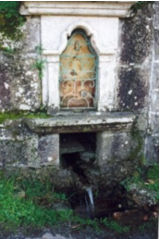
In the place of Borges, in the parish of Aboim da Nóbrega, there is still a fountain with small shrines next to a house (the Fountain of the Holy Tooth), where a man named Manuel António Martins (1920) lived. He possessed a tooth of St. Frutuoso—the abbot of Constantim (Vila Real)—which was believed to have exceptional powers to cure rabid dog bites. This tooth was already mentioned in the 17th century, and tradition says it was over eight hundred years old.
Manuel António belonged to the family known as “Os do Feitor,” or “Holy Teeth,” who had received the tooth from a single nobleman, who left it to a servant upon his death. The Holy Tooth, or Tooth of Saint Frutuoso, was also said to have been given directly by the Saint to the nobleman before he died, saying: “Whoever possesses this tooth will not be rich, but will always be provided for and will never lack necessities.” It could only be possessed by a man. The tooth was thus passed down from generation to generation.
It is said that many people came to Borges seeking the blessings of the Holy Tooth, and that no one in the village had ever died from rabies. The blessing was performed with the tooth (which was hung on a silver chain) along with the following prayer:
“In the name of the Father, the Son, and the Holy Spirit / And of St. Frutuoso / I bless you / And touched by me, you shall never be rabid.”
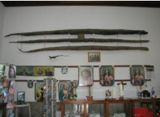
It is said that, one day in 1818, a Portuguese emigrant living in Brazil was walking along the Brazilian roads when he felt tired and decided to sit on what seemed to him a tree trunk.
Suddenly, the trunk began to move, and upon looking, the emigrant saw that it had transformed into a gigantic snake. In that moment of distress, the man called upon the goodwill of Our Lady of Alívio, promising her the snake’s skin if the saint helped him kill it. With the strength granted by Our Lady, the emigrant managed to grab the machete he carried at his waist and struggled fiercely with the powerful creature until he killed it.
In gratitude and in fulfillment of his promise, he brought the snake’s skin back to Portugal and offered it to Our Lady of Alívio at her sanctuary. Today, other snake skins from various parts of the world are also displayed there—places where Portuguese faced dangers and appealed for the help of Our Lady of Alívio, such as soldiers who went to defend the homeland in Africa during the Colonial War.

Coucieiro is one of the parishes that make up the municipality of Vila Verde. This parish has a historical and legendary story surrounding a nobleman, owner of an estate still known today as the Quinta de D. Sapo. This nobleman, dominant over his lands and those who worked them, represented the King and held all royal privileges or those granted by the King, plus additional privileges he invented himself due to the King being so far away—for example, the right to sleep with a bride after her marriage if she belonged to his domain.
One day, a tailor fell in love with one of these brides condemned to such a privilege. When he learned what was about to happen, he devised an acceptable revenge—he would present himself to the nobleman (disguised as a bride) and kill him. Acting on his plan, on the night after the marriage, he approached D. Sapo disguised as a bride and, with his weapon (a pair of scissors), killed him.
Everyone began to fear for their fate, and the tailor, fearing the justice that might come from the King for the homicide of his representative, decided to confess his crime directly to the King, saying: “I come to present myself to Your Majesty, asking for absolution, for there in the region of the Lords of Regalados I killed a Frog.”
The King thought and, looking at such a humble confession, said: “If you killed a frog (the King said, not remembering the nobleman), one more or one less, you are forgiven!” The tailor then gained courage and added: “That frog is the nobleman D. Sapo from our land, who, perhaps abusing his privileges, wanted to sleep with my bride.” The King, possibly displeased, had already said: “You are forgiven”—and a King’s word cannot be taken back.
And so, the men of that locality were freed to enjoy what they desired on the night of the wedding.
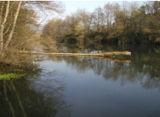
A young girl, accompanied by her father, was traveling along the road. When they came across a rock that provided good shade, the father and his daughter Joana stopped to rest.
Joana was also very thirsty, but there was no water there, and the water they carried had already run out.
She decided to look for a stream. When she found one, her eyes lit up with joy. She drank all the water she wanted and refreshed herself. But suddenly, a beautiful male voice whispered to her:
— For you, I would transform myself into a river, if necessary!
The young girl, very frightened, stood up. She looked around and said:
— I could have sworn I heard a man’s voice… Yet no one is here…
And she heard that beautiful voice again:
— You are mistaken… I am here as well, very close to you! Look down, to my water.
— Am I crazy… (the young girl said) or can a stream speak like a man?
— Not only can I speak, but I can also love. Yes… I am the stream that speaks to you.
Still a bit scared, Joana hesitated, and the stream explained:
— Any stream like me, when discovered for the first time by a maiden, can speak… listen… and even love! For this, your lips only need to touch my water and whisper: love!
The maiden, though suspicious, tried what the stream had instructed.
Suddenly, her father appeared, very worried, thinking she had gotten lost.
Joana told her father nothing of what had happened. Side by side, they continued their journey, but a strange sound seemed to follow them.
When night fell, the travelers looked for a place to sleep. But Joana was eager to know if the stream had kept its promise and had followed her this far. That noise could be nothing else… Carefully, so as not to wake her father, she went out to look for the stream.
To her amazement, the stream had now become a beautiful river.
Curious, the maiden asked the river:
— Do you only have a voice? Don’t you have a form?
The river asked her:
— Would you like to see me?
— Oh! I would so much!
Then the river fulfilled the wish of his beloved:
— Here I am!
Just then, the young girl’s father appeared, very angry:
— Joana! You betrayed me! You went to see a man!
— My father… I can explain…
But he did not even want to listen:
— I don’t want explanations! Come on! You will have no rest until the end of the journey.
The river, now transformed into a man, stayed there watching the beautiful maiden walk away.
It is said that the next day, many people heard a strange voice coming from the river, anxiously asking:
— Did the lady pass by here? Please answer me! Did she pass by here? Did she pass? …
This question, repeated a thousand times and heard by some who are no longer of this world, gave the name to those lands, which became known as Passô. And the river that flows through it is called the Rio Homem (Man River).
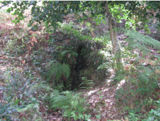
Of the Moorish women who once lived on Monte do Castelo, there was one who often came alone at night to drink from a fountain.
During a period of severe drought, the water gradually diminished until it disappeared, and the Moorish woman lamented the absence of her favorite water. Finally, after winter passed and the fountain’s delightful water returned, she resumed her unchanging habit.
A friar from the Convent of Santo António, located near the Castle by the fountain, was returning very late from a distant village where he had been on a mission with a companion who had died along the way, causing a great delay. Spotting a strange figure of a woman, alone and out of time, he followed her at a distance in silence, guided by his curiosity as a confessor.
When the beautiful Moor reached the fountain, she noticed the friar approaching too closely and asked by what right and for what purpose he was spying on her. The friar replied that seeing such a beautiful woman alone, at such a late hour and in such a deserted place, he had come to protect her from any possible danger. The Moor thanked him profusely.
Nothing more was said, and both fell asleep. This dialogue, along with other details, reached the Castle, where everything could be heard by enchantment. The master Moor, emerging from her concerns, suddenly appeared at the scene. Seeing only orange leaves from the garland of leaves and flowers that had previously adorned her subordinate, she condemned the friar to eternal enchantment, transforming him into a sardonyx, and turned the Moorish woman into a rose bush that still provides shade and camellias beside the fountain today.