
Traditions
Updated on 09/12/2025The Rooster Race and the Rooster’s Testament take the form of social satire, which, according to the memory of the oldest inhabitants, dates back to the mid-19th century.
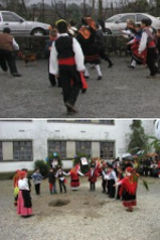
This began as a community festival with the purpose of gathering the population for a playful and recreational activity on Fat Sunday.
Various localities marked the occasion with the reading of the Rooster’s Testament, which announced its sad fate and rejoiced in the thought that it would be eaten by humans rather than end up buried in the ground:
“I leave, and it is my will / That my grave / Be inside human bodies, / Which is better than hard earth.”
After the reading of the testament, the rooster was thrown to the crowd—usually gathered in the largest and most central place of the parish—who rushed to catch it and enjoy its delicious meat.
Most localities eventually abandoned this practice, but the school community of EB 1 School in Francelos, in the town of Prado, keeps it alive and lively. Dressed in traditional Minho attire (no masks or other contemporary costumes), the children gather in the morning on the day before the start of the Carnival school holidays to uphold the tradition once more.
According to tradition, the students of each school year buy the best rooster from local farmers, which is later given to the teacher. Initially, the rooster was taken to the teacher’s home, who usually lived in the parish, but outside school hours. Now, the teacher receives it at the school immediately after the recital of the testament and the rooster race.
The roosters are placed in decorated carts and brought out to begin the ritual. The students place the rooster in a hole in the schoolyard, and once released, the chase begins to catch it and deliver it to the teacher. It is a hilarious moment that turns into a day of socializing and great fun for the entire school community.
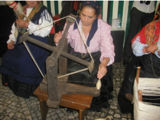
The first stage of linen production is cultivation. Usually sown at the end of April, around St. John’s Day, the linen is ready to be harvested using the “arriga” technique: the tender plants are uprooted and arranged in bundles.
Next, it is transported by ox cart, where it undergoes “ripa.” Then the “ougadoiros” are prepared: bundles buried near the river in small pits, covered with sand, for about a week. Afterward, the linen is taken to the threshing floor where it is stored and later beaten.
The linen is then crushed in a machine called an “engenho” and stored for a period that can last several months. The “espadelada” (or evening work) was a festive occasion: many people would gather late at night, working while enjoying games, challenge songs, and dancing. The bundles were separated on drying racks into fine linen, the actual linen, and “estopa,” used to make coarser garments.
Then it was time to take the distaff and spindle to spin the linen into skeins, which were then hung to dry. The next stage was boiling, which could be done in an oven or pots. After a sequence of washings, soaking, and boilings in water and ash to bleach the linen, the process was almost complete, leaving only the steps of folding, warping, and weaving the thread.
Although this traditional process, so slow and complex, has been largely replaced by industrial methods today, there are still those who remember and occasionally recreate these artisanal procedures to preserve this important tradition.

In the town of Prado, on Easter night, hundreds of people gather every year at the old Filipino bridge over the Cávado River to observe a tradition lost in the mists of time.
This is a ritual of unknown origin, legend associating it with the prevention of headaches throughout the year. It is believed that anyone who eats a boiled egg on the bridge when the clock strikes midnight, throwing the shells into the river while chanting hallelujahs, or eats almonds on that same day, will remain free from headaches for the entire year.
Oblatas were made on the eighth day after a person’s death; they correspond to our requiem mass. Relatives and friends gathered at the home of the bereaved and then processed to the church, where the parish priest said a prayer appropriate for the occasion. At the end, everyone gave the priest an alms, which was never less than a small coin, covering the cost of each prayer offered for the soul of the deceased: this was the oblata. The custom of giving alms on the day of the funeral also existed in Vila Verde.
There was another type of oblata in the municipality of Vila Verde: the parish priest would send a cart to the homes of parishioners to collect the oblata, receiving from each widower or single person a handful of corn, or two if married.
For each baptism or wedding, the priest received a chicken and two loaves of bread, and at Easter, eggs or sponge cake, wheat, or money as a token of the parishioners’ generosity in gratitude for the visit of the Cross.
It is also an extinct custom and took place during Lent. At the time when the trinity bells rang (at the end of the day), people would gather in a remote place and begin loudly singing a song dating back to the 17th century.
“O my brothers, children of Jesus Christ!
Remember the blessed souls,
Who suffer the pains of purgatory.”
This practice, created under the pretext of praying for the souls in purgatory, ended with the silent recitation of an Our Father and a Hail Mary. This custom, which is part of the Minho folklore, began in the municipality of Vila Verde, in Cervães, by the founder of the Sanctuary of Our Lady of Good Dispatch, the hermit João da Cruz.
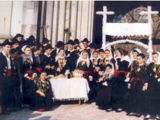
The Wedding Arch was placed at the church door so that the bride and groom could pass underneath. This arch was made with rods, decorated with quilts, handkerchiefs, pieces of bragal, and gold cords.
On a table, bread and wine were placed.
All of this symbolized the abundance associated with the bride in the objects of the chest, and with the groom, in the bread and wine.
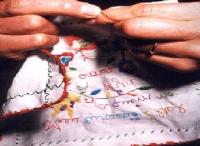
It is believed that the origin of the Lover’s Handkerchiefs dates back to the attire of noblewomen in the 17th and 18th centuries, from which they were adapted by common women. They thus acquired simpler expressions in terms of the techniques and materials used in their creation, with the purpose of winning over their beloved.
Linen was partially replaced by cotton, giving rise to the so-called “troop handkerchiefs” sold at fairs. Cross-stitch embroidery was partially replaced by running stitch, stem stitch, and satin stitch, which were easier to execute, and even the colors were changed.
Black and red were replaced by a wide variety of colors, introducing enormous chromatic richness. The embroidered motifs were highly diverse, reflecting the taste of each embroiderer, who used religious symbols, hearts and keys, butterflies, pairs of lovers, and others. As for the texts, they could take the form of single words, phrases, or quatrains. Through them, the creator would, more or less explicitly, express her feelings for the young man, who, if interested in the courtship, would wear the handkerchief around his neck.

On the night of April 30th to May 1st, the “devil” goes from door to door to find the lazy girls, and they reveal themselves by not making the beautiful flower crowns to place on their doors or the facades of their houses as a sign of “here is a marriageable girl.”
Every girl must say “no” to the devil’s visit, which automatically signals that there is a good prospect for a future home. If she doesn’t have time to make an artistic maio, a simple branch of flowering broom has the same meaning. During the night, the girls hide behind the windows to watch their suitors.
The boys, in turn, try to “steal” the maio from the one who has already touched their heart. Thus, throughout the night, a youth full of joy and courage searches for the maio of his beloved, which is sometimes not easy, because on purpose, the maio is tied with tricks or placed in a hard-to-reach spot. It is in this simple act that the courage of her suitor is revealed.